


On June 25th, Senator Cassidy released a discussion draft of the 340B for Patients Act, proposing changes to the program that build on the investigative 340B report he put out in late April of last year. We shared our own recommendations on 340B reform last year in response to Senator Cassidy's original report.
That said, Cassidy's draft is one of three reform efforts in play. On the House side, Rep. Scott Peters introduced the SECURE 340B Act on July 1st, and on the Senate side, the bipartisan working group known as the “gang of six” has been crafting the SUSTAIN 340B Act, though its membership has turned over (Thune left to lead the majority, and Boozman replaced Mullin) and its introduction has stalled.
Across all three bills, the publicly stated intention has been the same: to improve transparency and oversight while better translating the program into meaningful impact for underserved communities.
Distilling the Intention of 340B Criticism
Much of the current assault on 340B comes down to a lack of agency; that is, 340B is one of the few levers on drug pricing that pharmaceutical companies have limited control. Resultant messaging on 340B (and the lobbying behind it) has produced the bills we have seen introduced in Congress as of late.
What we find lost in the public discourse, though, is where the money actually sits. The overwhelming majority of 340B purchasing is concentrated in hospitals, with the Congressional Budget Office (CBO) reporting that roughly 87 percent of 340B drug spending flows through hospital outpatient settings and their off-site clinics. We should therefore be careful not to let questions aimed at large hospital systems, which drive most of the program's spend while making up a minority of covered entities, spill over onto the clinics.
Our work sits with safety net clinics rather than hospital systems, so the perspective we offer here speaks to grantees alone and not to how hospitals draw on the program. What we can speak to is that if 340B were distilled down to the safety net clinics that account for only 13 percent of program spend (yet form the backbone of what 340B was built to do), the controversy that is now driving reform would fall away.
Our Thesis
We are aligned with the stated intent behind all three efforts but part ways on execution. More specifically, Cassidy's draft as written will create serious and lasting harm for the safety net clinics that transparently and authentically serve the most vulnerable communities across the country, and, by extension, for the patients who turn to those clinics for HIV testing, treatment, and prevention they often cannot find anywhere else. You cannot purify a program by starving the very institutions it was built to sustain.
We organize this piece around the issues that matter most to safety net grantees and highlight where each of the three bills lands on each point. All current bills face uphill odds this session, and meaningful reform is unlikely to be implemented in 2026. As such, the purpose is less about any single draft and more about the principles that should guide whatever reform eventually moves.
Where the Three Bills Land
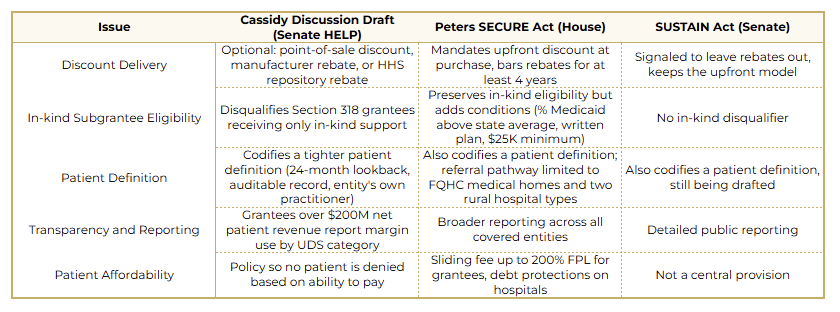
Issue 1: How Discounts Are Delivered
Cassidy's 340B for Patients Act would let manufacturers choose one of three methods to deliver 340B pricing: 1) a direct point-of-sale discount, available only to covered entities that maintain physical inventories and submit claim-level documentation; 2) a retrospective rebate requested directly from the manufacturer or its contractor; or 3) a rebate paid after claims data is submitted to an HHS-operated repository, again limited to entities with physical inventories, among other requirements.
The House SECURE Act goes the other way, requiring manufacturers to offer the ceiling price as a reduction in the purchase price rather than a retrospective rebate for at least four years, with data flowing through an independent clearinghouse instead of the manufacturer (with a narrow exception for IRA-selected drugs ).
The Senate working group has signaled that the SUSTAIN Act is unlikely to include rebate provisions at all, and that its clearinghouse is meant to catch duplicate discounts, not to convert the program into a rebate.
We remain consistent with our earlier work in holding that a point-of-sale discount is essential to preserving the original intent of 340B. Traditionally, 340B discounts are applied at the point of sale; covered entities buy drugs at the discounted 340B price and are reimbursed at commercial rates, realizing savings immediately and reinvesting into patient care.
Every rebate model, whether the manufacturer runs it or HHS operates the repository, creates significant capital expenditure challenges by shifting the timing of those savings from upfront to retroactive. Our previous analyses of the drugs in the HRSA rebate pilot found that a small FQHC would likely need an additional $23,000 to $51,000 in cash on hand each month, potentially more than the clinic clears in monthly 340B savings. That is money that would otherwise pay for the labs, care navigation, and case management that keep patients in treatment, sitting frozen in inventory instead.
At scale, rebates would deepen the working capital crisis these clinics already face and, in doing so, keep patients from receiving the discounted medications and wraparound services that 340B savings make possible. This does not even account for the cost of building new systems to submit and track claims, nor the risk of rebates that are delayed or denied in adjudication.
The burden of managing rebates would disproportionately harm good faith safety net clinics who have less net working capital to invest in the necessary ongoing management systems for a rebate model. Large hospitals tend to have the cash reserves and credit to float immediate cash flow challenges, while safety net grantees run on tight budgets and depend on immediate savings.
There is also the question of who holds the data. Putting claims data, and the pricing decisions that follow from it, in the hands of the manufacturer, as Cassidy's draft would allow as one of the options, lets the manufacturer hold the data, judge each claim, and decide the payment.
In essence, our objection is to the optionality to choose a rebate itself. A menu that includes rebate models opens a door to endangering safety net providers that must stay closed. HRSA's own pilot was halted by a preliminary injunction precisely because of the potential harm to covered entities and their patients; even that pilot, for all its challenges, at least enables HRSA to iterate over time as they learn from the pilot.
Manufacturers argue that rebates are a way to verify eligibility before a discount is honored, which they say would curb duplicate discounts, diversion, and overlapping concessions under the IRA's maximum fair price rules. However, a data and verification problem does not require shifting financial risk onto safety net clinics to solve it. The House bill highlights a better path: keeping the upfront discount in statute and handling integrity concerns like duplicate discounts through a neutral clearinghouse. Such an approach answers the transparency questions while avoiding perverse financial incentives for manufacturers, all while keeping every dollar of capital at clinics focused on the patient experience.
Issue 2: STD Grantee and Subgrantee Eligibility
Under Cassidy's discussion draft, covered entities that qualify for 340B through Section 318 grant status would face a set of new conditions. They would have to report their public or nonprofit status, certify that their 340B revenues are consistent with the scope of the grant, and verify that their patient population is primarily low income or uninsured, all of which most clinics already do. The draft would then go a step further and make an entity ineligible if it receives only an in-kind contribution.
In contrast, the House bill retains in-kind STD grant eligibility while adding key conditions: a written plan tying the in-kind support to the grant's goals, a $25,000 annual minimum, and a requirement that the share of Medicaid patients aged 19 to 64 exceed the statewide average.
We believe the disqualification of STD in-kind grantees is one of the most damaging provisions in Cassidy’s discussion draft. As we noted when Senator Cassidy first released his report, most Section 318 STD grants are awarded to state and county health departments and then carried out through in-kind contributions, consisting of tools like testing kits and educational or capacity-building resources. Roughly 55 percent of registered STD clinics qualify through in-kind support rather than direct funding, making up the majority of STD grantees.
In-kind grants matter because they let an STD clinic operate as an extension of its local health department. The kits and resources are not the whole of their value; they are what allow a grantee to put additional drugs in patients' hands at reduced cost, multiplying the benefit across everything else a patient needs. Stripping away in-kind STD grant qualification for 340B would hollow out disease control, surveillance, and linkage to care.
The draft offers no meaningful alternative and no transition plan, which risks leaving most Section 318 STD grantees without the resources they need to keep their doors open. It also says nothing about what fills the gap if 55 percent of STD clinics lose 340B, and with it up to 90 percent of the operating budget that pays for HIV testing, linkage to care, and treatment and prevention. To implement this piece of the bill is to put the very backbone of the effort to end the HIV epidemic at risk.
Issue 3: Transparency and Reporting
Cassidy's draft offers new annual reporting requirements: grantees with net patient revenue at or above $200 million would report how they use their 340B margin across UDS-aligned expenditure categories. The House bill reaches further, applying reporting to every covered entity without the $200 million threshold that shields smaller grantees in Cassidy's version. The Senate draft likewise calls for detailed reporting that the Secretary would publish.
This tracks closely with what we recommended back in April of last year, namely anchoring reporting to existing UDS requirements, and it largely reflects data that clinics already capture. Our caution is narrow. Clinics that already operate under extensive federal oversight (including existing UDS obligations) should not have new layers stacked on top, since that kind of duplication falls hardest on the safety net providers with the clearest track record of delivering strong public health outcomes.
Issue 4: Patient Affordability
Under Cassidy's draft, grantees would have to adopt a policy ensuring that no patient is denied a 340B drug based on ability to pay. The House bill sets a sliding-fee standard up to 200 percent of the federal poverty level for grantees, or recognizes existing sliding-fee compliance, and reserves its tougher medical-debt protections for hospitals.
This mostly asks grantees to formalize what their authorizing statutes already require. FQHCs and similar grantees have run sliding-fee models for decades. The cleanest version of this provision, which the House bill tracks with, is to let existing sliding-fee compliance at FQHCs and FQHC look-alikes satisfy the requirement rather than layer a new standard on clinics that are already doing the work.
Conclusion
Some form of 340B reform is coming, and across all three efforts we share an envisioned destination of a program that is transparent, accountable, and genuinely reaches the underserved. We fully support that destination but object to any route that steamrolls through the safety net. An impulse to reform 340B can protect these clinics or starve them, and it is the details of eligibility, pricing, and reporting that decide which.
Where a bill keeps the point-of-sale discount, preserves in-kind grantees, and keeps reporting proportionate to size, it shows that integrity and protection are not at odds. Where it does not, it puts the clinics on the front line of the HIV epidemic at risk for problems they did not create.
Hence, we ask for precision, whatever vehicle of reform advances. 340B improves access to care without adding to the taxpayer's burden, and whatever ultimately passes should protect and strengthen the role that FQHCs, Ryan White grantees, and STD clinics play in delivering real public health outcomes.

Each dollar of in-kind support delivered through a health department partner is magnified by 340B into the 80 to 90 percent of an STD clinic's operating budget that the program sustains. This makes in-kind support a near-perfect example of grantees stretching scarce federal resources exactly as 340B intended.

Peter Park
Founder and Co-CEO, Alchemy

