




Most of the people I talk with about HIV treatment aren't worried about whether their medication works. Modern regimens are remarkably good at keeping the virus suppressed. What they worry about is everything else: the weight they've gained, the new blood pressure pill that might interact, the five tablets they still take every morning because of resistance picked up in the 1990s.
That's why 2026 has been a meaningful year. The FDA approved two new once-daily, single-tablet regimens: Merck's Idvynso in April and Gilead's Bixlenvo in August. A once-weekly pill also finished Phase 3 trials this summer. None of these are meant for someone who was just diagnosed. They're switch options for people who are already undetectable, which, these days, is most of the people we care for.
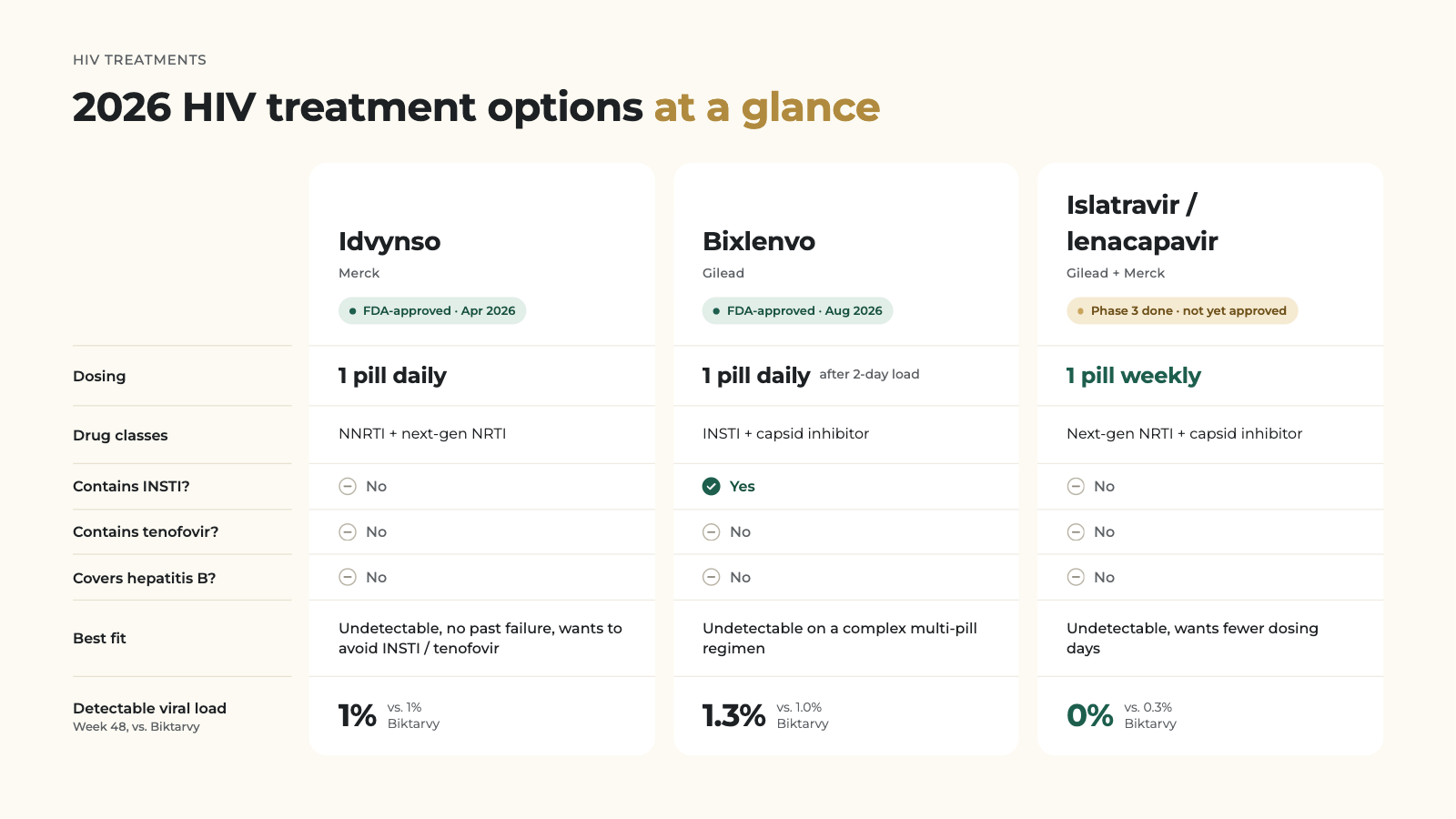
Newly approved and emerging regimens
Idvynso (doravirine/islatravir) - Merck, approved April 21, 2026
What it is: A single daily tablet with two drugs: doravirine 100 mg and islatravir 0.25 mg. It's approved for adults who are undetectable on a stable regimen, have never had a treatment failure, and have no doravirine resistance. It reached pharmacies in mid-May.
How it works: Both components target reverse transcriptase, the enzyme HIV uses to convert its RNA into DNA. Doravirine is an NNRTI many of us already know from Pifeltro and Delstrigo. Islatravir is a nucleoside analog, but it behaves differently from the NRTIs we've used for decades. It blocks the enzyme from moving along the strand, which stops DNA synthesis immediately, and it also distorts the DNA that does get made.
Why it matters: Most commonly used regimens contain an integrase inhibitor, often paired with tenofovir. Idvynso offers an alternative without either. It's the first two-drug regimen without an INSTI or tenofovir. I think of it first for patients with INSTI-associated weight gain, declining kidney function or bone density on tenofovir, or a medication list long enough to make interaction checks a project.
What the data show: Approval rested on two Phase 3 switch trials, with 708 participants taking Idvynso.
- Trial 052 was double-blind against Biktarvy. At week 48, about 1% in each arm had a viral load of 50 copies/mL or higher demonstrating non-inferioriority to Biktarvy.
- Trial 051 compared Idvynso with whatever people were already taking. Only 1% on Idvynso were detectable at week 48, compared with 5% who stayed put.
- Weight was essentially unchanged: an average of -0.03 kg on Idvynso vs. +0.28 kg on Biktarvy.
- Tolerability was good. Diarrhea, dizziness, fatigue, bloating, and headache each showed up in 3% of people or fewer, and only 0.5–3% stopped because of side effects.
- Safety signals to keep in mind: one case of severe immune thrombocytopenia about a month in, which resolved after stopping, and one case of DRESS. Doravirine also carries a warning for severe skin reactions. These are rare, but I'd counsel patients to report any new rash or unusual bruising promptly.
Trial 051 enrolled 40% women and 45% Black participants. Those are the people most affected by HIV in the U.S., and they've historically been underrepresented in registrational trials. It makes the results easier to trust for the patients many of us actually see.
Bixlenvo (bictegravir/lenacapavir) - Gilead, approved August 27, 2026
What it is: A once-daily tablet combining bictegravir 75 mg and lenacapavir 50 mg. It's the smallest complete HIV tablet on the market. It's approved for adults who are undetectable with no resistance to either component, but its real purpose is clear from the trials: it's built for people stuck on complicated, multi-pill regimens.
How it works: Bictegravir is the integrase inhibitor from Biktarvy, here at a higher 75 mg dose. It keeps HIV from inserting its DNA into the host cell. Lenacapavir is a capsid inhibitor, the first drug in its class. The capsid is the protein shell around the viral genome, and lenacapavir disrupts it at several points: getting into the nucleus, assembling new virus, and releasing it. Because nothing else works this way, it has no known cross-resistance with existing drug classes.
Why it matters: Some patients with long treatment histories still need complicated, multi-pill regimens.. They were diagnosed in the '80s or '90s, survived the monotherapy era, and carry resistance that rules out every standard single-tablet regimen. So they take three, five, sometimes eleven pills a day, some of them twice daily. They're often in their 60s and managing heart disease, diabetes, or kidney issues on top of HIV. Bixlenvo is the first one-pill option for most of them. It's also free of tenofovir and emtricitabine, which matters for people who've accumulated NRTI resistance.
Starting requires a two-day lead-in. On days 1 and 2, the patient takes one Bixlenvo plus two Sunlenca (lenacapavir 300 mg) tablets. From day 3 on, it's one Bixlenvo daily, with or without food. If a patient misses more than seven days, they need to restart the lead-in.
What the data show:
- ARTISTRY-1 enrolled the oldest population ever studied in a Phase 3 HIV treatment trial, with a median age of 60 and a median of 28 years on therapy. Participants took 2 to 11 pills a day, and 67% had documented NRTI resistance. In other words, these were real-world complex patients. At week 48, 0.8% on Bixlenvo were detectable vs. 1.1% who stayed on their existing regimen.
- Lipids improved after switching. Median total cholesterol dropped 15 mg/dL, compared with a 2 mg/dL increase in the comparison group.
- ARTISTRY-2 compared Bixlenvo head-to-head with Biktarvy. Detectable rates were 1.3% vs. 1.0%, meeting non-inferiority, with no meaningful weight change.
- Side effects were mild: headache (4%), nausea (3%), and diarrhea (2%).
- Resistance: No capsid mutations emerged. One participant developed an isolated integrase substitution without phenotypic resistance.
ARTISTRY-1 was published in The Lancet and ARTISTRY-2 in The Lancet HIV. Both Bixlenvo and Idvynso have since been added to the HHS adult treatment guidelines as options for people with ongoing viral suppression.
Coming soon: a once-weekly pill (islatravir/lenacapavir)
This one isn't approved yet, but anyone following HIV research has been watching it closely. Gilead and Merck combined islatravir and lenacapavir into one tablet taken once a week. If it's approved, it would be the first weekly oral HIV treatment.
The 48-week Phase 3 results, presented at AIDS 2026 in July, were strong:
- ISLEND-1 (double-blind vs. Biktarvy): 0% on the weekly pill were detectable at week 48, vs. 0.3% on Biktarvy. Side effects and discontinuations were nearly identical between arms.
- ISLEND-2 (vs. a range of daily regimens): 0.3% on the weekly pill were detectable vs. 1.3% on daily therapy. Participants also reported higher treatment satisfaction and lower treatment burden.
- In 2021, a higher dose of islatravir caused drops in total lymphocyte and CD4 counts, and Merck paused its trials. The ISLEND regimen uses a much lower weekly dose, and CD4 and lymphocyte counts stayed stable through week 48. No one stopped treatment because of them.
Both companies say these data will form the basis of their FDA submissions, so a decision in 2027 seems realistic.
Key considerations
None of these is the right choice for everyone. Here's how I'd weigh each one when talking through a switch.
Idvynso
- Not for anyone with past treatment failure or doravirine resistance
- Can't be taken with lamivudine or emtricitabine, or with strong CYP3A inducers (some seizure drugs, rifampin, St. John's wort)
- Doesn't treat hepatitis B. People with HBV coinfection who switch need a separate plan
- Rare but serious risks: severe skin reactions and one case of severe low platelets
- Islatravir's earlier safety history may make some prescribers cautious until long-term data pile up
Bixlenvo
- Two-day loading phase with additional Sunlenca tablets adds complexity at initiation
- If more than 7 days of doses are missed, the loading phase must be restarted
- Can't be taken with dofetilide or strong CYP3A inducers, and has other interaction flags
- Doesn't contain tenofovir or emtricitabine, so it doesn't cover hepatitis B
- Bictegravir levels drop in pregnancy, so viral load needs close monitoring
Islatravir/lenacapavir (weekly, not yet approved)
- Not available yet
- Missing a weekly dose may carry more risk than missing a daily one, real-world adherence data will matter
- Long-term safety beyond 96 weeks is still being studied
What does this mean for patients?
I want to be clear about one thing: if someone is undetectable, feeling well, and has no issues with their current regimen, there's no reason to switch. Biktarvy and the other INSTI-based regimens remain excellent, and all three new options were tested against them and came out roughly even, not better.
What's changed is how much room we have to tailor treatment. Not long ago, a patient who couldn't tolerate integrase inhibitors, or whose resistance history locked them into a multi-pill routine, had very few good alternatives. Now there's a two-drug daily pill with no INSTI or tenofovir, a single small tablet for people with complex resistance, and a weekly option likely on the way.
If you're living with HIV and something here sounds relevant to you, bring it up at your next appointment. These are the questions I'd want you to ask:
- Do I have any resistance history that would rule one of these out?
- Do I have hepatitis B, and how would switching affect that?
- Will any of my other medications interact?
- Is it covered by my insurance, or is there a manufacturer copay program?
When I think about where HIV treatment started, handfuls of pills, strict dosing schedules, side effects that made people choose between their health and their quality of life, this year's approvals are a good reminder of how far we've come. The goal is no longer just viral suppression. It's finding a regimen each person can live with comfortably for decades, and in 2026 we have more ways to do that than ever.
Sources
- Merck. FDA approves Merck’s once-daily IDVYNSO (doravirine/islatravir). Published April 21, 2026. Accessed November 5, 2026. https://www.merck.com/news/fda-approves-mercks-once-daily-idvynso-doravirine-islatravir/Merck.com
- Gilead Sciences. U.S. FDA approves Gilead’s Bixlenvo, a new once daily single tablet option for virologically suppressed adults with HIV, including those on complex regimens. Published August 27, 2026. Accessed November 5, 2026. https://www.gilead.com/news/news-details/2026/u-s--fda-approves-gileads-bixlenvo-a-new-once-daily-single-tablet-option-for-virologically-suppressed-adults-with-hiv-including-those-on-complex-regimensgilead.com
- Gilead Sciences. Gilead’s single tablet regimen of bictegravir and lenacapavir maintained virological suppression in people with HIV who switched antiretroviral therapy. Published February 2026. Accessed November 5, 2026. https://www.gilead.com/news/news-details/2026/gileads-single-tablet-regimen-of-bictegravir-and-lenacapavir-maintained-virological-suppression-in-people-with-hiv-who-switched-antiretroviral-therapy gilead.com
- Gilead Sciences; Merck. Investigational once weekly oral HIV treatment regimen of islatravir and lenacapavir maintained virological suppression in adults with HIV who switched antiretroviral therapy. Published July 21, 2026. Accessed November 5, 2026. https://www.gilead.com/news/news-details/2026/investigational-once-weekly-oral-hiv-treatment-regimen-of-islatravir-and-lenacapavir-maintained-virological-suppression-in-adults-with-hiv-who-switched-antiretroviral-therapy gilead.com
- US Department of Health and Human Services. What’s new. Guidelines for the use of antiretroviral agents in adults and adolescents with HIV. Clinicalinfo.HIV.gov. Accessed November 5, 2026. https://clinicalinfo.hiv.gov/en/guidelines/hiv-clinical-guidelines-adult-and-adolescent-arv/whats-new
- Gallagher A. Results show single-tablet regimen of bictegravir/lenacapavir maintains virological suppression of HIV. Drug Topics. Published February 27, 2026. Accessed November 5, 2026. https://www.drugtopics.com/view/results-show-single-tablet-regimen-of-bictegravir-lenacapavir-maintains-virological-suppression-of-hiv Drug Topics
- Orkin C, Mngqibisa R, Velez JD, et al. Switch to fixed-dose doravirine (100 mg) and islatravir (0·25 mg) once daily in virologically suppressed adults with HIV-1 on oral antiretroviral therapy: 48-week results of a phase 3, multicentre, randomised, open-label, non-inferiority trial. Lancet. 2026;407(10528):599-610. doi:[10.1016/S0140-6736(25)01945-2](https://doi.org/10.1016/S0140-6736(25)01945-2). pubmed.ncbi.nlm.nih.gov
- Colson AE, Mills AM, Ramgopal MN, et al. Switch to fixed-dose doravirine (100 mg) and islatravir (0·25 mg) once daily in virologically suppressed adults with HIV-1 on bictegravir, emtricitabine, and tenofovir alafenamide: 48-week results of a phase 3, multicentre, randomised, controlled, double-blind, non-inferiority trial. Lancet.2026;407(10528):611-621. doi:[10.1016/S0140-6736(25)01948-8](https://doi.org/10.1016/S0140-6736(25)01948-8). pubmed.ncbi.nlm.nih.gov
- Orkin C, Ruane PJ, Hedgcock M, et al. Switch to single-tablet bictegravir-lenacapavir from a complex HIV regimen (ARTISTRY-1): a randomised, open-label, phase 3 clinical trial. Lancet. 2026;407(10535):1249-1258. doi:[10.1016/S0140-6736(26)00307-7](https://doi.org/10.1016/S0140-6736(26)00307-7). pubmed.ncbi.nlm.nih.gov
- Meissner EG, Ramgopal M, Ruane PJ, et al. Safety and efficacy of switching to bictegravir-lenacapavir versus continuing bictegravir-emtricitabine-tenofovir alafenamide in virologically suppressed people with HIV-1 (ARTISTRY-2): a double-blind, multicentre, randomised, controlled, phase 3, non-inferiority trial. Lancet HIV.2026;13(8):e538-e547. doi:[10.1016/S2352-3018(26)00078-0](https://doi.org/10.1016/S2352-3018(26)00078-0). PubMed
- Rockstroh JK, Ramgopal MN, Curran Fàbregas A, et al. Phase 3 trial of weekly oral islatravir-lenacapavir for HIV-1 treatment. N Engl J Med. 2026;395(13):1299-1309. doi:[10.1056/NEJMoa2607973](https://doi.org/10.1056/NEJMoa2607973). PubMed
- Colson AE, Kumar PN, Ruane PJ, et al. Switch to once-weekly, single-tablet islatravir-lenacapavir from daily standard of care for HIV-1 (ISLEND-2): a multicentre, randomised, open-label, active-controlled, phase 3 non-inferiority trial. Lancet. 2026;408(10557):821-832. doi:[10.1016/S0140-6736(26)01442-X](https://doi.org/10.1016/S0140-6736(26)01442-X).


